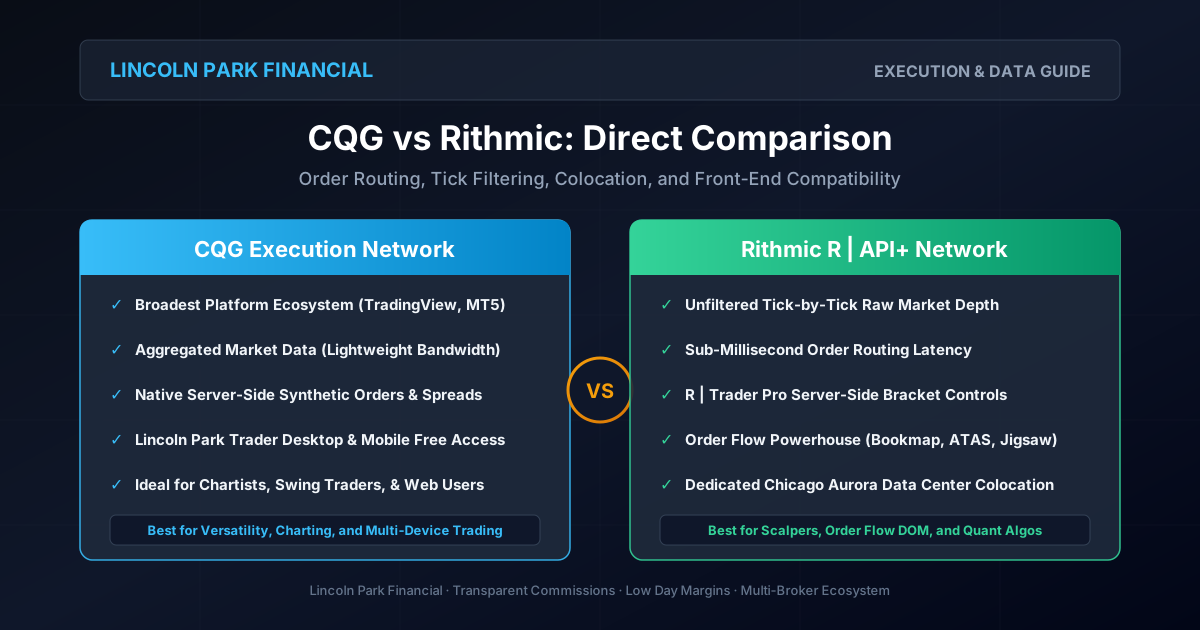
Quick answer: CQG and Rithmic are both futures order routing and market data networks that Lincoln Park Financial clients can use for CME Group markets. CQG groups trades into consolidated data updates and supports live trading inside TradingView, while Rithmic sends unaggregated Market by Order (MBO) depth used by order flow platforms such as Sierra Chart and Bookmap. The choice usually depends on which trading platform you use and how much order book detail your strategy needs.
Last updated November 4, 2026. Reviewed by the Lincoln Park Financial broker team.
Choosing between CQG and Rithmic is one of the most critical infrastructure decisions an active futures trader will make. Both networks deliver institutional-grade direct market access to the CME Group, ICE, and Eurex, but they are built for fundamentally different trading workflows, charting ecosystems, and execution models.
Choose CQG → If you prioritize multi-device cloud synchronization, native direct routing inside TradingView, mobile execution, and zero monthly connection fees covered by Lincoln Park Financial.
Choose Rithmic → If you trade high-frequency order flow, scalping DOMs (Bookmap, Sierra Chart Denali, Jigsaw DayTradr), or require unaggregated MBO (Market by Order) tick-level depth.
Direct Gateway Comparison Matrix
Here is how the two leading futures execution gateways compare across latency, data feed structure, and platform support:
| Feature / Specification | CQG Gateway | Rithmic (R|Trader Pro) |
|---|---|---|
| Primary Strength | Cross-platform ecosystem & TradingView native integration | Sub-millisecond raw MBO tick depth & DOM queue tracking |
| Data Architecture | Filtered packet delivery (smooth mobile & cloud charting) | Unaggregated tick-by-tick market depth (every queue change) |
| TradingView Live Trading | Native & Supported (Direct login in TradingView) | Requires 3rd-party webhook bridge or adapter |
| Supported Software | TradingView, CQG Desktop, MultiCharts, Bookmap, ATAS | Sierra Chart (Denali), Bookmap MBO, Jigsaw, Quantower |
| LPF Cost Structure | $0 Monthly Platform & Routing Fees (Covered by LPF) | Standard monthly exchange & Rithmic platform connection rates |
| Clearing FCM Access | StoneX & Ironbeam ($50 Micro / $500 Mini Margins) | StoneX & Ironbeam ($50 Micro / $500 Mini Margins) |
Data Feed Architecture: Aggregation vs. Raw MBO Depth
The single biggest technical difference between CQG and Rithmic is how market data packets travel from the CME Globex matching engine in Aurora, Illinois to your screen.
CQG: Streamlined Packet Filtering
CQG uses an intelligent packet filtering mechanism. When hundreds of trades occur within the exact same millisecond on high-volume contracts like E-Mini S&P (ES) or Micro Nasdaq (MNQ), CQG groups them into consolidated updates. This prevents bandwidth bottlenecks, keeping charts butter-smooth even during extreme volatility events like Non-Farm Payrolls or FOMC rate announcements.
Rithmic: Raw Unaggregated Depth
Rithmic delivers raw, unaggregated Market by Order (MBO) depth. Every individual order placed, modified, or canceled in the exchange order book is sent as a distinct packet. For algorithmic scalpers using heatmap software like Bookmap or order flow tools in Sierra Chart, Rithmic provides the raw granularity required to see passive limit orders absorbing aggressive volume.
Platform & Software Compatibility
Your choice of execution gateway dictates which front-end charting and order entry platforms you can deploy in live trading:
→
CQG Desktop
→
Sierra Chart
→
Bookmap
→
ATAS / MultiCharts
CQG vs Rithmic: Frequently Asked Questions
What is the difference between CQG and Rithmic?
The main difference is how market data reaches your screen. CQG groups trades that occur in the same millisecond into consolidated updates, which keeps charts responsive on desktop, cloud and mobile. Rithmic sends raw, unaggregated Market by Order depth, so every order placed, modified or canceled in the book arrives as a separate update.
CQG vs Rithmic: which one works with TradingView?
CQG supports live trading inside TradingView with a direct login. Rithmic does not connect natively to TradingView and requires a third party bridge or adapter.
Rithmic vs CQG: which one fits order flow trading?
Traders who read Market by Order depth in tools such as Bookmap, Sierra Chart (Denali) or Jigsaw often choose Rithmic because it sends every change in the order book. Traders who focus on charting across several devices or trade through TradingView often choose CQG. Your platform list is usually the deciding factor.
Which trading platforms connect to CQG and Rithmic?
On this page, CQG is listed with TradingView, CQG Desktop, MultiCharts, Bookmap and ATAS, and Rithmic is listed with Sierra Chart (Denali), Bookmap MBO, Jigsaw and Quantower. Confirm your exact platform version with a broker before you open an account.
How much do CQG and Rithmic cost?
Platform, routing and exchange market data fees differ between the two networks and can change. See our CQG Pricing and Fees, Rithmic Pricing and Fees, CQG Market Data and Rithmic Market Data help pages for current details.
Can I switch between CQG and Rithmic at Lincoln Park Financial?
Lincoln Park Financial is an independent introducing broker, and clients can set up either CQG or Rithmic, subject to account approval. Call a broker at 312 500 4730 to review which connection matches your platform and markets. Trading futures involves substantial risk of loss and is not suitable for all investors.
Where Lincoln Park Financial Fits
At Lincoln Park Financial, you never have to settle for a single clearing firm or restrictive routing provider. As an independent introducing brokerage, we provide dual clearing access through both StoneX and Ironbeam, enabling you to deploy CQG or Rithmic with tailored day trading margins starting at $50 for Micro contracts and $500 for standard E-minis.