
E-mini Natural Gas futures (QG) are listed on NYMEX, part of CME Group, and cover 2,500 million British thermal units (MMBtu) of natural gas, one quarter of the 10,000 MMBtu in a standard Henry Hub Natural Gas (NG) contract. Four QG contracts equal the quantity of one NG contract.
QG is financially settled. Instead of delivering gas, each expiring QG contract is closed out in cash against the final settlement price of the matching NG contract. That lets traders follow Henry Hub prices at a quarter of the standard quantity without a delivery process.
QG is quoted in dollars and cents per MMBtu and moves in increments of $0.005, half a cent, so each tick is worth $12.50 per contract. That tick is coarser than the $0.001 tick used on NG and MNG. QG trades on CME Globex during the NYMEX natural gas session, and trading in each month ends on the business day before the last trading day of the matching NG contract.
E-mini Henry Hub Natural Gas
QG
NYMEX (CME Group)
2,500 MMBtu
Sunday to Friday on CME Globex, 5:00 PM to 4:00 PM CT, halted daily from 4:00 PM to 5:00 PM CT
$0.005 per MMBtu = $12.50
Every calendar month for the current year and the next five years; the following year is added once the December contract stops trading.
Financially settled (cash) to the NG final settlement price
Day Trading Margins
Overnight Margins
QG margins sit alongside NG and MNG on our futures margins page. For the full size contract see Henry Hub Natural Gas (NG), and for the smallest size see Micro Natural Gas (MNG). To trade QG, open an account or request a commission quote.
Source: CME
The above information is derived from sources believed to be accurate. It is provided without guarantees and is subject change without notice.
Because QG settles against NG, it responds to the same supply and demand information as the standard contract. The points below explain what QG traders follow; they are not a forecast.
With a $12.50 tick, a one cent move in natural gas equals $25 per QG contract. Trading QG involves substantial risk of loss.
E-mini natural gas futures give exposure to 2,500 MMBtu of Henry Hub natural gas per contract, a quarter of NG. QG is listed on NYMEX and closes out in cash at expiration.
QG covers 2,500 MMBtu and NG covers 10,000 MMBtu, so four QG contracts equal one NG contract. The smaller size lets traders take natural gas positions in smaller quantities.
The minimum move is $0.005 per MMBtu, worth $12.50 per QG contract.
QG moves in half cent increments while NG moves in tenths of a cent. So one QG tick ($12.50) is larger than one NG tick ($10.00), even though QG covers a quarter of the gas.
A $0.10 per MMBtu move is 20 QG ticks, or $250 per contract.
No. At expiration, open QG positions are settled in cash at the final settlement price of the corresponding NG contract. No gas changes hands.
QG trading ends on the business day before the last trading day of the matching NG contract, so QG expires one business day ahead of NG.
QG requires $300 for intraday trading and $1,428 to hold a contract overnight. Current amounts are on the margins page.
QG follows the NYMEX natural gas session on CME Globex: it opens Sunday at 5:00 p.m. CT and closes Friday at 4:00 p.m. CT, with an hour long halt beginning at 4:00 p.m. CT on weekdays.
Traders who want Henry Hub price exposure without a delivery obligation, and smaller commercial hedgers whose gas volumes are only a fraction of a full NG contract.
QG tracks the NG futures price, which is based on delivery at Henry Hub in Louisiana. At expiration the QG settlement price equals the NG final settlement price for that month.
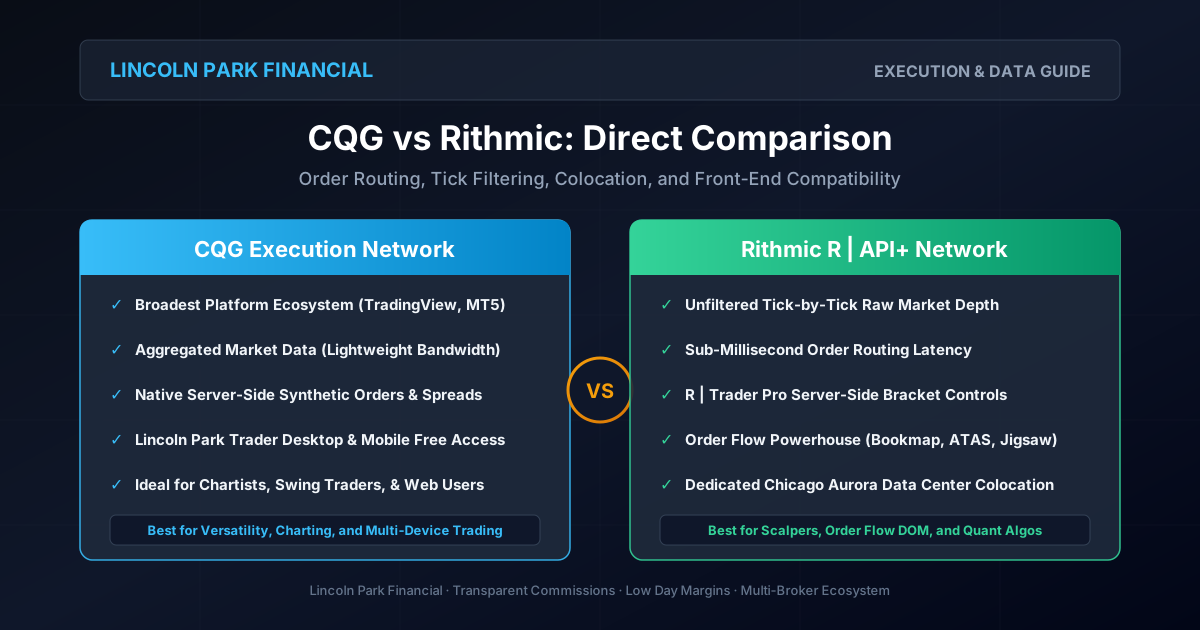
Live QG prices come from NYMEX and are part of the CME bundle of market data; CQG, Rithmic and Sierra Chart all display them.

Speak with our experienced futures brokers at 312-500-4730 to discuss how we can service your futures trading needs.