Updated August 21, 2026
Best Futures Trading APIs: CQG vs Rithmic, Ironbeam & TT
The best futures trading API depends on what you are building. Rithmic is often a strong fit for low-latency market data and order-flow workflows, CQG offers a broad mix of client and enterprise connectivity, Ironbeam provides a native REST and WebSocket API, and Trading Technologies is built for professional SDK, FIX, risk, and post-trade integrations.
This guide compares the four futures API solutions available to eligible Lincoln Park Financial clients and explains how to choose based on programming language, market data, order routing, hosting, platform compatibility, and account structure.
Written by the Lincoln Park Financial team and reviewed for brokerage and market-access accuracy by Jose Lozada, an NFA-registered Associated Person.
What Is the Best API for Futures Trading?
There is no single best futures trading API for every trader. The right choice depends on whether you need detailed market depth, a simple REST connection, a Python workflow, a Windows or Linux SDK, FIX connectivity, multi-account controls, or integration with a specific futures trading platform.
- Rithmic: often best suited to low-latency trading, detailed market data, Market-by-Order workflows, order-flow tools, and developers using Rithmic’s API suite.
- CQG: often best suited to traders and firms that want broad global connectivity, client APIs, enterprise Web API access, FIX connectivity, analytics, and established third-party platform support.
- Ironbeam xAPI: often best suited to developers who want a native FCM API using REST for requests and WebSockets for streaming market and account data.
- Trading Technologies: often best suited to professional and institutional workflows requiring .NET, C++, FIX order routing, FIX market data, drop copy, risk controls, and operational integration.
Before building or deploying an algorithmic model, verify your trading economics by reviewing our futures day trading margins and transparent futures commission rates. You can also explore our full suite of supported futures trading platforms.
The most important decision is not simply which API has the longest feature list. It is which complete setup, broker, FCM, API, routing technology, market data, hosting environment, and trading platform, supports the way your system will actually operate.
Futures Trading API Comparison
| API Provider | Strongest Fit | Primary Connectivity | Market Data | Common Development Path | Important Access Consideration |
|---|---|---|---|---|---|
| Rithmic | Low-latency trading, order flow, MBO, custom platforms, algorithmic systems | R | API+, R | Protocol API, gated R | Diamond API | Real-time depth, MBO, historical and exchange-connected data depending on service and permissions | C++, Python and supported protocol integrations | API access, exchange data and production permissions must be approved for the specific broker/FCM setup |
| CQG | Broad market access, analytics, client applications, enterprise systems and FIX | Client APIs, Web API, FIX Connect and other enterprise services | Level 1, Level 2, historical ticks, bars and global market data depending on product | Local client applications, language-neutral Web API workflows and FIX | Client APIs require CQG Integrated Client on the same machine; enterprise products have separate onboarding |
| Ironbeam xAPI | Native broker/FCM API, automated strategies, custom applications and fintech integrations | REST plus WebSockets | Real-time data, unfiltered Level 2, historical data and account streams depending on permissions | Python, C#, C++, JavaScript, Java or any language that can use HTTP and WebSockets | Credentials, exchange subscriptions, account permissions and production access depend on the approved configuration |
| Trading Technologies | Institutional execution, professional algos, FIX, risk, drop copy and back-office workflows | .NET SDK, Core SDK, FIX and REST API | Real-time market data through SDK/FIX plus reference, account and historical services | C#/.NET, C++ on Linux, FIX and REST | Different TT APIs serve different functions; licensing, testing and production approval may apply separately |
This table is a practical selection guide, not a performance guarantee. Features, exchange access, pricing, market-data entitlements and approvals vary by provider, FCM and account configuration.
How a Futures Trading API Connection Works
A futures API is one layer of a larger trading stack. Your strategy does not normally connect to an exchange in isolation. The order passes through approved technology, account-risk controls and clearing infrastructure before reaching the market.
Typical order path:
Strategy or custom application → API, SDK or FIX session → broker/FCM permissions and risk controls → routing infrastructure → futures exchange
Typical data path:
Futures exchange → market-data infrastructure → API or platform connection → strategy, charting application or risk system
This is why a developer should evaluate the entire setup before writing production code. An API may support a language or order type in theory, but the live account still needs the correct clearing relationship, exchange entitlement, market-data package, account permission and production credential.
API vs Trading Platform vs Data Feed vs Webhook
These terms are related, but they are not interchangeable:
- Trading API: a programmatic interface for data, orders, accounts or other trading functions.
- Trading platform: the user-facing software used for charting, order entry, analytics and account monitoring.
- Routing technology: the infrastructure that carries orders between the trading application, risk system and exchange.
- Market-data feed: a stream of quotes, trades, depth or historical information; it may or may not include order entry.
- Webhook: an event-driven message sent from one application to another. A webhook can trigger an automated workflow, but it is not automatically a complete trading API.
- Platform scripting language: code that runs inside a platform, such as a strategy or study. It may use the platform’s connection rather than a direct external API credential.
How to Choose a Futures Trading API
1. Start With the Required Workflow
Define what the application must do before comparing providers. A market-data collector, a single-account Python strategy, a multi-account execution engine and a compliance drop-copy system have very different requirements.
Write down whether the system needs to:
- Receive Level 1, Level 2 or Market-by-Order data
- Submit, modify and cancel orders
- Use server-side brackets, OCOs, synthetic spreads or algorithms
- Monitor balances, positions, margins, fills and order states
- Trade one account or multiple accounts
- Run locally, on a VPS, in the cloud or on colocated infrastructure
- Connect to risk, compliance, middle-office or back-office systems
2. Match the API to the Programming Language
REST and WebSocket APIs are generally accessible from many languages. Native SDKs may be tied to C++, C#/.NET, a specific operating system or a particular deployment model. FIX is language-neutral at the protocol level, but it requires a FIX engine, session management and deeper institutional-development experience.
3. Determine the Market-Data Detail
A strategy using one-minute bars does not have the same data needs as an order-book model. Confirm whether the system needs top-of-book quotes, aggregated depth, full depth, Market-by-Order, tick history, bar history, instrument definitions or replay data.
4. Evaluate Order Handling and Risk Controls
Compare supported order types, time-in-force instructions, parent/child behavior, bracket logic, OCO handling, spread support, cancellation behavior and broker-side risk controls. Ask what remains active if the local application disconnects.
5. Understand Latency Without Chasing a Marketing Number
API latency is not one universal number. It depends on the location of the strategy, network route, provider gateway, exchange, message type, market conditions, account-risk checks and how the application is written. A realistic evaluation measures the complete round trip from the deployed system rather than relying on a single advertised figure.
6. Confirm Simulation, Testing and Production Requirements
Determine whether a simulator uses the same endpoint and message structure as production, whether live market-data fees apply during testing, and whether the provider requires conformance testing, certification or a technical review before live deployment.
7. Calculate the Total Cost of the Stack
API cost is only one component. Include platform charges, routing fees, exchange market data, professional or non-professional data status, server hosting, FIX sessions, dedicated infrastructure, certification, support and clearing costs.
8. Choose the Broker and FCM Before Finalizing the Code
One of the most expensive mistakes is developing around an API before confirming that the intended broker, FCM, account type, exchange and market-data package support it. Verify the full configuration first, then build against the approved test environment.
Rithmic API
Rithmic provides futures trading infrastructure for market data, order routing, account access and custom trading applications. It is widely used with professional charting, order-flow and algorithmic trading software.
Rithmic API Options
- R | API+: a C++ development path for custom trading systems and platforms.
- R | Protocol API: a protocol-based option that includes a Python development path.
- R | Diamond API: a gated, ultra-low-latency option intended for qualifying production users and supported FCM configurations.
Rithmic Strengths
- Detailed exchange-connected market data
- Market-by-Order and depth workflows where supported
- Low-latency order-routing infrastructure
- Server-side risk and account controls
- Multiple developer options for different languages and deployment requirements
- Broad compatibility with professional futures platforms
Who Rithmic Is Usually Best For
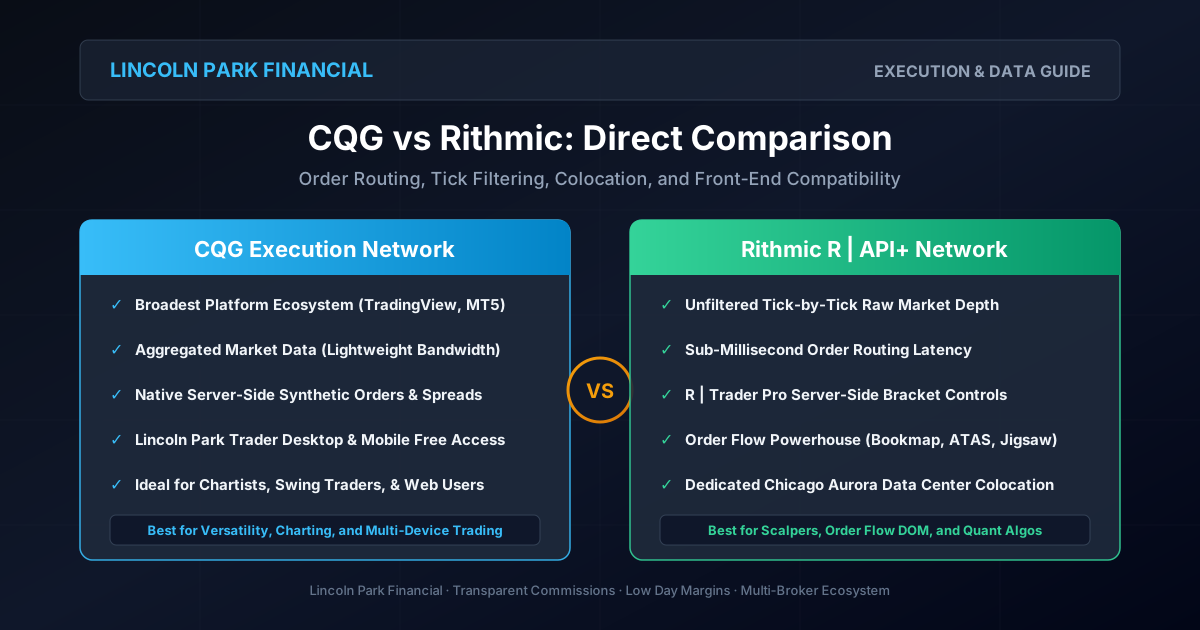
Rithmic is often a strong fit for order-flow traders, active futures traders, platform developers, quantitative teams and algorithmic traders that require detailed market data and a high-performance connection.
Rithmic-Compatible Platforms
Depending on the broker and account configuration, Rithmic may be used with platforms such as Sierra Chart, Bookmap, Quantower, MotiveWave, Jigsaw and R | Trader Pro.
Rithmic Considerations
- Not every broker or FCM supports every Rithmic service.
- Direct API access is different from logging into a Rithmic-connected trading platform.
- Market-data entitlements and exchange fees still apply.
- Production API access may require approval, testing and technical experience.
- The correct Rithmic option depends on language, deployment and latency requirements.
Best summary: Choose Rithmic when detailed futures market data, order-flow compatibility and high-performance routing are more important than having a simple generic REST interface.
CQG APIs
CQG offers market data, analytics and order-routing APIs for individual developers, software providers, trading firms and enterprise systems. CQG states that its network provides direct market access to more than 45 exchanges and consolidates data from more than 85 global sources.
CQG Client APIs
CQG Client APIs are designed for individual-user applications and operate through CQG Integrated Client. CQG states that these APIs must run on the same machine as Integrated Client. Depending on the service, they can support market data, analytics, order routing, trade monitoring and automated workflows.
CQG Web API
CQG describes Web API as its flagship enterprise data and trading API. It uses secure WebSockets and Google Protocol Buffers and can provide streaming Level 1 and Level 2 data, historical ticks and bars, order execution, account information, order history and post-trade functions.
CQG FIX Connect
FIX Connect is intended for professional environments that need standardized order routing and risk connectivity. Potential uses include algorithmic systems, proprietary order-management systems, execution desks, customer risk applications and operational integrations. CQG requires conformance testing for live FIX applications.
CQG Strengths
- Broad exchange and market-data coverage
- Client and enterprise connectivity options
- Real-time and historical data
- Trading, account and analytics services
- WebSocket/Protocol Buffers and FIX development paths
- Established CQG platforms and third-party integrations
Who CQG Is Usually Best For
CQG is often a strong fit for traders and firms that want market data, routing, analytics and multiple connectivity options within one established ecosystem. It can serve an individual desktop application, a proprietary platform or a larger enterprise connection, depending on the product selected.
CQG Considerations
- A CQG platform login does not automatically include full API access.
- Client APIs require Integrated Client and applicable services.
- Enterprise API access may require separate commercial onboarding and technical review.
- FIX applications require conformance testing before production.
- Exchange data, API services, routing and licensing may be billed separately.
Best summary: Choose CQG when broad market access, mature analytics, multiple API tiers and the ability to grow from a local application into an enterprise or FIX workflow matter most.
Ironbeam xAPI
Ironbeam xAPI is a native futures trading API that connects approved custom applications, algorithms and trading interfaces to Ironbeam’s clearing and trading infrastructure. It combines REST endpoints with WebSocket streaming.
REST API
REST is used for request-and-response actions such as submitting, modifying or cancelling an order; requesting account information; reviewing positions; retrieving fills; and accessing supported historical information.
WebSocket Streaming
WebSockets keep an open connection and push updates to the application as they become available. Depending on permissions, streams may include real-time quotes, unfiltered Level 2 depth, chart data, order updates, fills, positions and balances.
Ironbeam xAPI Strengths
- REST endpoints that are familiar to many software developers
- WebSocket streaming for market and account updates
- Native connection to an FCM’s infrastructure
- Real-time Level 2 data and account monitoring depending on permissions
- Language flexibility for Python, C#, JavaScript, Java, C++ and other HTTP/WebSocket environments
- Potential single-account, multi-account and enterprise use cases
Who Ironbeam xAPI Is Usually Best For
Ironbeam xAPI is often a strong fit for independent developers, algorithmic futures traders, proprietary firms and fintech teams that want a modern REST/WebSocket architecture without starting with a native desktop SDK or FIX session.
Ironbeam xAPI Considerations
- Confirm production credentials, account permissions and exchange subscriptions before development.
- Review supported order types, brackets, OCO behavior and rate limits for the intended strategy.
- Verify whether the application will manage one account or multiple accounts.
- Test disconnect recovery, order-state reconciliation and duplicate-order prevention.
- Do not assume a demo environment has identical fills or market behavior to live trading.
Best summary: Choose Ironbeam xAPI when a straightforward REST and WebSocket development model and a native FCM connection are the priorities.
Trading Technologies (TT) APIs
Trading Technologies provides several APIs and SDKs for professional trading, custom execution, market data, risk, account administration and post-trade operations. TT is not one API; it is a group of developer products designed for different functions.
TT .NET SDK
TT .NET SDK is designed for custom .NET applications that need real-time prices, instrument lookup, order routing, order and fill events, positions and account information. It is commonly used for Windows-based execution tools and proprietary trading applications.
TT Core SDK
TT Core SDK is a C++ development path for high-performance server-side applications on Linux. It is more appropriate for experienced teams building latency-sensitive execution engines, market-making applications, automated strategies or colocated systems.
TT FIX
TT FIX services include order routing, market data and drop copy. FIX can connect proprietary OMS and execution systems, distribute normalized market data and send real-time execution reports to risk, compliance, middle-office and back-office systems.
TT REST API
TT REST API is suited to product information, account administration, permissions, risk limits, historical transactions and related platform services. It should not be treated as the primary connection for every latency-sensitive, streaming order-and-fill workflow; TT’s SDK or FIX products are generally more appropriate for those functions.
TT Strengths
- Professional .NET and C++ SDKs
- FIX order routing, market data and drop copy
- Institutional risk and operational integrations
- Multi-account and multi-user workflows
- Client-side, server-side and advanced deployment models
- Support for custom execution and proprietary trading systems
Who TT Is Usually Best For
TT is often a strong fit for professional trading firms, CTAs, CPOs, hedge funds, commercial hedgers, execution desks, OMS providers and technology teams that need more than a simple trading bot connection.
TT Considerations
- Select the API based on the actual function: execution, data, risk, administration or post-trade.
- Confirm Windows, Linux, server-side and hosting requirements.
- FIX, SDK and REST access may have different credentials, licensing and approval processes.
- Testing, certification or production review may be required.
- TT is generally a more advanced implementation than a basic REST bot.
Best summary: Choose TT when the system requires institutional-grade SDK or FIX connectivity, multi-account controls, operational integration or a professional execution stack.
Which Futures API Fits Each Use Case?
| Use Case | API to Evaluate First | Why |
|---|---|---|
| Python trading bot using streaming data | Ironbeam xAPI or Rithmic R | Protocol API | Both provide a viable Python development path, but the architecture and permissions differ |
| Order-flow or MBO application | Rithmic | Detailed market-data and professional order-flow ecosystem |
| Local CQG-connected custom application | CQG Client API | Designed to work through CQG Integrated Client on the same machine |
| Cloud or enterprise CQG application | CQG Web API or FIX Connect | Enterprise connectivity, streaming data and order-routing options |
| REST/WebSocket application connected to an FCM | Ironbeam xAPI | Native REST requests and WebSocket streams |
| Windows-based professional execution application | TT .NET SDK | Native .NET workflow for data, orders and account events |
| Linux low-latency server application | TT Core SDK or qualifying Rithmic API | C++ and advanced deployment options |
| OMS, risk, compliance or drop-copy integration | TT FIX or CQG FIX Connect | Standardized institutional messaging and operational integration |
What Is the Best Python API for Futures Trading?
For a developer specifically searching for a Python futures trading API, the first practical comparison is usually between a protocol or REST/WebSocket connection and a platform-based integration.
- Ironbeam xAPI: Python can call REST endpoints and maintain WebSocket subscriptions using common HTTP and WebSocket libraries.
- Rithmic R | Protocol API: Rithmic identifies Python as a supported development path within its API suite.
- CQG Web API: Google Protocol Buffers are language-neutral, so a qualifying enterprise implementation can be built in supported development environments, including Python-based systems, subject to CQG onboarding and specifications.
- TT: TT’s primary execution SDK paths are .NET and C++, while FIX can be implemented with a Python-compatible FIX engine. TT REST is useful for supported administrative and reference workflows but is not a universal replacement for TT’s real-time execution interfaces.
Python is productive for research, automation and many execution strategies, but the language alone does not determine performance. Network placement, message handling, event loops, serialization, logging, risk checks and recovery logic can matter as much as the API name.
Futures API Developer Checklist
Before requesting production access, confirm each item below.
- The exact exchange, product and contract types the system will trade
- Whether futures options, spreads or only outright futures are required
- Level 1, Level 2, MBO, historical tick, bar or replay requirements
- Supported order types, time-in-force instructions, brackets and OCO behavior
- Maximum order and message rates
- Authentication, session renewal and credential-storage requirements
- Order-state recovery after a restart or network interruption
- Duplicate-order prevention and idempotency strategy
- Position and fill reconciliation against the broker/FCM source of truth
- Maximum position, daily loss and emergency kill-switch controls
- Simulation limitations and production approval requirements
- Professional versus non-professional market-data classification
- All API, routing, platform, data, hosting and clearing costs
- Support contacts and escalation procedures during live trading
Minimum Live-Risk Controls
An automated futures system should be designed for failure, not only for the expected trade path. At minimum, consider controls for rejected orders, partial fills, stale market data, duplicate messages, disconnections, exchange halts, contract rollover, position mismatches, excessive order rates and emergency liquidation.
Accessing Futures APIs Through Lincoln Park Financial
Lincoln Park Financial works with self-directed traders, developers, professional firms, CTAs, CPOs and commercial market participants evaluating futures trading technology. Through our clearing relationships, eligible clients may be able to access Rithmic, CQG, Ironbeam’s native API and Trading Technologies, depending on the account structure and approved configuration.
Before an account is opened or configured, our team can review:
- The application’s trading and market-data requirements
- Preferred programming language and hosting model
- Single-account or multi-account needs
- Required exchanges and futures products
- Trading-platform compatibility
- Simulation, certification and production requirements
- Applicable API, routing, platform and market-data costs
Building a futures trading application? Contact Lincoln Park Financial before finalizing your integration so the API, FCM, exchange access and account permissions can be reviewed as one complete setup.
Discuss an API Setup | Open a Futures Account | Call 312-500-4730
Futures Trading API FAQs
Is there one best futures trading API?
No. Rithmic, CQG, Ironbeam and TT are designed for different workflows. Choose based on the required data, language, hosting, order functions, account structure and broker/FCM support.
Can I trade futures with Python?
Yes, when the approved API provides a Python or language-neutral connection. Ironbeam’s REST/WebSocket architecture and Rithmic’s protocol API are two paths to evaluate. Enterprise CQG or FIX workflows may also be implemented in Python-capable environments.
Is Rithmic a broker?
No. Rithmic is a futures trading infrastructure and connectivity provider. A trader still needs an account through a broker and clearing firm that supports the required Rithmic connection.
Is CQG API access included with every CQG login?
No. CQG platform access and CQG API access are not the same. Client APIs require CQG Integrated Client and applicable services, while enterprise products have separate onboarding, permissions and commercial requirements.
What is the difference between REST, WebSocket, SDK and FIX?
REST is request/response, WebSockets stream events over an open connection, an SDK provides native software libraries, and FIX is a standardized financial messaging protocol commonly used by professional firms.
Do I need a funded account before receiving API credentials?
Requirements vary by provider, test environment and account type. Some providers offer demos before production, while live credentials require an approved account, permissions and market-data entitlements.
Can a futures API trade CME Group and Coinbase Derivatives contracts?
Potentially, yes, when the provider, FCM, exchange permissions and account configuration support those products. Product availability must be confirmed before development or trading.
Can CTAs and CPOs use futures APIs?
Yes. APIs can support model execution, multi-account workflows, risk monitoring and reporting, but the appropriate setup depends on account structure, allocation requirements, supervision and regulatory obligations.
Does using an API guarantee faster fills?
No. An API can automate order submission and reduce manual steps, but fills depend on price, queue position, liquidity, order type, exchange conditions, network performance and the complete routing path.
Can I test a futures API before trading live?
Many providers offer a simulation or certification environment. Confirm whether it uses the same endpoints and messages as production and remember that simulated fills do not reproduce every live-market condition.
What does a futures trading API cost?
Total cost may include API access, routing, platform charges, exchange market data, professional data fees, FIX sessions, hosting, certification and clearing. Request a complete cost review for the intended configuration.
What happens if my API disconnects?
The answer depends on where orders and risk logic are held. Developers should document reconnect behavior, working-order recovery, position reconciliation and the status of server-side orders before trading live.